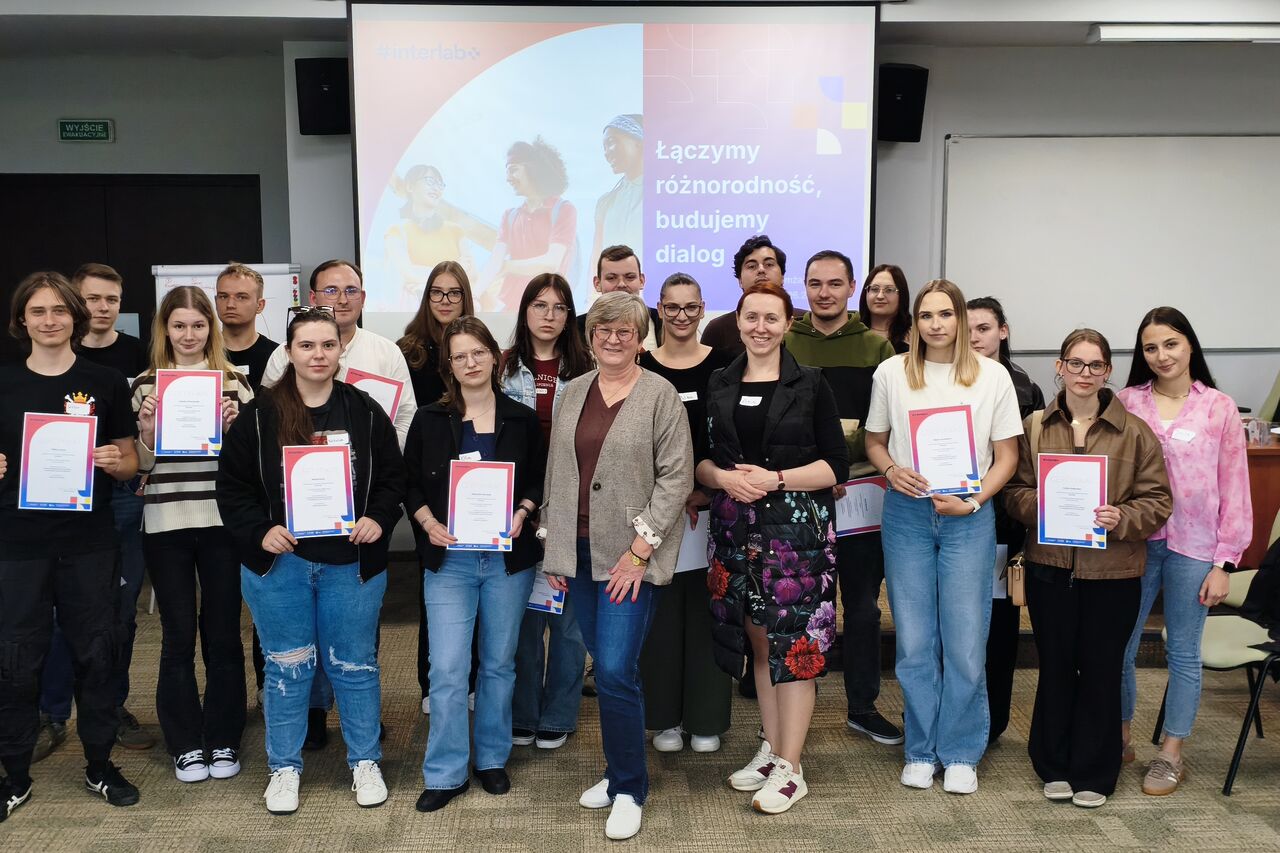
On June 2 and 3, 2026, University of Lomza hosted the #interlab+ intercultural workshops, organized in cooperation with the Foundation for the Development of the Education System (FRSE). The event brought together students interested in intercultural communication, international cooperation, and building competencies essential for functioning in an increasingly diverse academic and professional environment. The workshops provided an excellent opportunity to acquire new knowledge, develop communication skills, and view cultural diversity from a broader perspective.
The workshops were led by experienced trainers cooperating with the Foundation for the Development of the Education System – Jolanta Sobesiuk and Anna Skocz. Both have been involved for many years in activities related to intercultural education, social communication, and supporting dialogue between representatives of various environments and cultures.
Jolanta Sobesiuk, an intercultural and anti-discrimination trainer as well as a public dialogue facilitator, shared her knowledge and experience gained during numerous social and educational projects aimed at promoting multiculturalism and building an open society. In turn, Anna Skocz, a certified intercultural trainer and educator, familiarized participants with issues related to functioning in an international environment, intercultural communication, and the challenges that may arise during cooperation between people from different cultural backgrounds.
The trainers' professionalism, openness to dialogue, and ability to create an atmosphere conducive to the free exchange of thoughts encouraged participants to eagerly engage in subsequent activities, share their own experiences, and actively participate in discussions.
The workshop program covered issues related to intercultural competencies, the iceberg model of culture, culture shock, strategies for coping in new social and cultural conditions, and Geert Hofstede's cultural dimensions. There was also an analysis of real-life situations and case studies, which allowed participants to better understand the challenges arising during intercultural contacts.
However, the greatest value of the meetings proved to be the conversations, reflections, and exchange of experiences among participants. Among the students taking part in the workshops were many beneficiaries of the Erasmus+ program, including both individuals who had completed long-term student mobilities and participants of Blended Intensive Programmes (BIP) – short-term, international intensive programs organized by partner universities.
Students eagerly shared their experiences gained during foreign trips, talking about cooperation in international teams, cultural differences, and challenges related to communication and the implementation of joint projects. Particularly interesting were the discussions regarding BIP programs, during which participants work for several days in mixed, international groups on a joint project, and then present the results of their work to other participants. Such experiences require not only substantive knowledge, but also openness, flexibility, and the ability to cooperate with people representing different communication styles and various cultural perspectives.
The workshops were attended by students of English Philology, Management, Administration, and Law, who already have experience related to international mobilities. There were also individuals preparing for their first trips abroad. Among them were Pedagogy students who will take part in a Blended Intensive Programme in Malta in just a few weeks. Thanks to this, the workshops became not only an opportunity to acquire new knowledge, but also a space for exchanging practical tips, experiences, and inspiration between students at various stages of their international adventure.
Many discussions went beyond the framework of the program, becoming an inspiring space for exploring different points of view, breaking down stereotypes, and building mutual understanding.
A special value of the workshops was their interactive format. Alongside the theoretical part, participants took part in exercises, case studies, team tasks, and conversations based on their own experiences. Thanks to this, the discussed issues did not remain merely theory, but became a starting point for deep reflection on their own attitudes, communication methods, and functioning in a culturally diverse environment. Participants repeatedly emphasized that the opportunity to exchange opinions and experiences with other students was one of the most valuable elements of the training.
The workshops showed that intercultural competencies are not limited solely to knowledge of other cultures. Above all, they are the ability to listen, conduct dialogue, build relationships based on mutual respect, and consciously function in a diverse social environment. Developing these competencies is becoming extremely important today in both academic and professional life, especially in the context of growing international mobility and cross-border cooperation.
In evaluation questionnaires, students rated both the substantive level of the workshops and the way they were conducted very highly. Special recognition was gained by the practical nature of the classes, the open atmosphere conducive to discussion, and the engagement of the trainers. Participants emphasized that the workshops allowed them to look at many issues from a new perspective, better understand the mechanisms of intercultural communication, and acquire skills useful both during foreign mobilities and in their future professional work.
The event was carried out as part of the #interlab+ project, run by the Foundation for the Development of the Education System and funded by the European Union. The initiative supports the development of intercultural competencies, promotes dialogue, and builds a society open to diversity. Thanks to their participation in the workshops, students of University of Lomza were able to develop skills particularly important in the context of international cooperation, educational mobility, and functioning in a multicultural academic and professional environment.
The implementation of the #interlab+ workshops once again confirmed how important it is to create spaces for meeting, conversation, and mutual acquaintance. We are glad that students of University of Lomza participated in the event in such large numbers and with such active involvement, demonstrating openness, commitment, and readiness to develop competencies of particular significance in the modern world.