
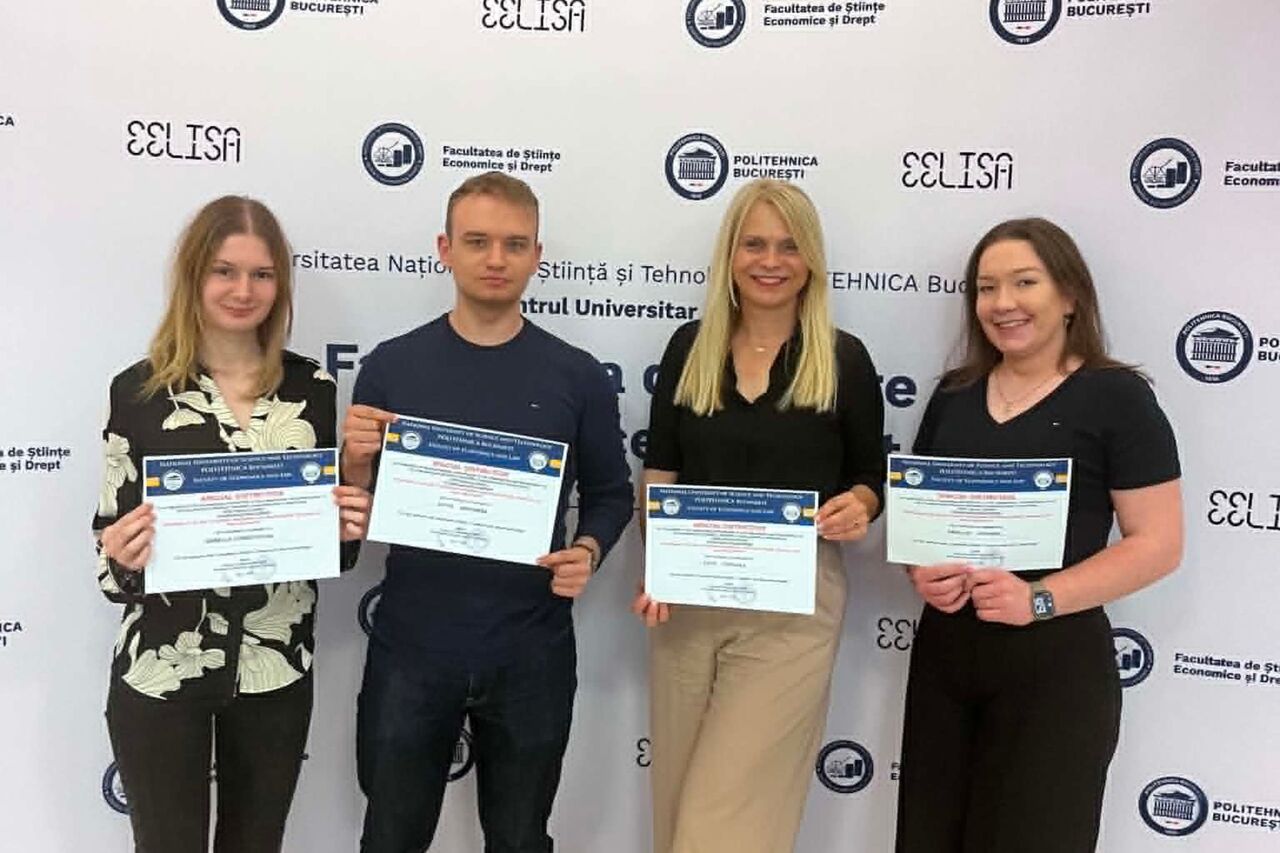
Izabella Chrostowska and Dawid Sztandera received a special distinction during the International Students’ Scientific Conference “Challenges in the Age of Artificial Intelligence and Sustainability. Economic and Legal Approaches”, organized as part of the Blended Intensive Programme “#StudentsCHALLENGES: Artificial Intelligence in Students’ Scientific Research”.
The conference took place on May 7, 2026, at National University of Science and Technology POLITEHNICA Bucharest at the University Centre of Pitești campus in Romania and formed part of an international programme dedicated to trends, ethics, and applications of artificial intelligence in business and law. Students from University of Lomza prepared a scientific paper entitled “Artificial Intelligence in Justice: Promise, Peril and the Path Forward” in cooperation with students from European University of Law and Administration, Karolina Jakubiak and Anna Patelska. Their presentation focused on the opportunities, risks, and future of artificial intelligence in the justice system.
Out of 21 papers presented during the conference, only 6 received distinctions from the international assessment committee composed of representatives of POLITEHNICA Bucharest. The award granted to the students from the University of Lomza reflected the high academic quality of their paper and the relevance of the topic concerning the dynamic development of artificial intelligence and its impact on modern legal systems.
The BIP “Artificial Intelligence Trends, Ethics and Applications in Business and Law” was conducted in a blended mobility format. Part of the programme was held online at the end of April, while the on-site mobility took place from May 4 to May 8, 2026, in Pitești. The programme brought together students and academic staff from numerous partner universities across Europe and Asia, aiming to develop competencies related to the use of artificial intelligence in scientific research, law, economics, and education.
During the week-long programme, participants attended workshops, expert lectures, and mentoring sessions devoted to research methodology, the use of AI tools in data analysis, artificial intelligence ethics, European Union regulations, and the impact of AI on democracy, education, and the labour market. An important aspect of the programme was also the international cooperation between students and the preparation of their own scientific projects presented during the final conference.
Universities from Romania, Poland, Bulgaria, Georgia, Ukraine, Indonesia, Türkiye, and Moldova participated in the programme, providing students with an opportunity to exchange experiences and explore artificial intelligence from different academic and cultural perspectives.